Homeschool Daily Schedule Ideas That Actually Work
Practical homeschool schedule ideas including flexible routines, block scheduling, morning baskets, and tips for managing multiple ages at home.

Disclosure: This post contains affiliate links. If you purchase through my links, I may earn a small commission at no extra cost to you. I only recommend products I genuinely love and believe in. Thank you for supporting Eventful Eve! 🤍
If there's one question I get more than any other from new homeschool moms, it's "What does your day actually look like?" And I get it. When you're coming from a traditional school model where someone else sets the bell schedule, the idea of structuring your own day feels massive. Here's the truth that took me way too long to learn: the best homeschool schedule is the one your family will actually stick to. Not the one that looks perfect in a bullet journal. Not the one the veteran homeschool mom posted on her blog. The one that matches your family's natural rhythms, your kids' attention spans, and your own capacity. Let me share some approaches that have worked for us and for other families I know.
Routine vs. Schedule: An Important Distinction
Before we get into specific schedules, I want to make a distinction that changed everything for me.
A schedule is time-bound: Math at 9:00, reading at 9:45, science at 10:30. It's tied to the clock.
A routine is order-bound: We do math first, then reading, then science. It flows based on when we're ready, not what time it is.
I started with a detailed schedule — color-coded, laminated, the works. It lasted about three days before I wanted to cry. We were constantly running behind, I was stressed about transitions, and the whole thing felt like we'd just recreated school at home.
When I switched to a routine — a predictable order of activities without rigid times — everything clicked. We still get everything done. We just do it at our own pace. Some days we're finished by noon. Some days we take a long break in the middle and finish after lunch. The flexibility is the whole point.
The Morning Basket
This has been the single best addition to our homeschool day. A morning basket (or morning time) is a block of time where the whole family gathers together for shared subjects — things like poetry, picture study, composer study, read-alouds, hymns, Bible, or nature observation.
Why it works:
- It sets a calm, connected tone for the day
- You cover multiple "subjects" in one enjoyable block
- Kids of all ages can participate together
- It builds family culture and shared references
- It takes the pressure off — this part feels more like bonding than schoolwork
What ours looks like:
- A poem from our current collection (we rotate monthly)
- A chapter from our family read-aloud
- A short artist or composer study (we look at a painting or listen to a piece of music and discuss it)
- A hymn or folk song
- Sometimes a Scripture passage or character discussion
The whole thing takes about 30-45 minutes and it's genuinely everyone's favorite part of the day. Even my kid who would happily skip everything else looks forward to morning basket.
Sample Schedule: The Structured Morning
This works well for families who like clear expectations and want to front-load academics:
| Time Block | Activity |
|---|---|
| 8:30 - 9:00 | Morning basket (together) |
| 9:00 - 9:30 | Math (independent or guided) |
| 9:30 - 9:45 | Break / snack |
| 9:45 - 10:15 | Language arts (reading, writing, grammar) |
| 10:15 - 10:45 | History or science (alternating days) |
| 10:45 - 11:00 | Break / outdoor time |
| 11:00 - 11:30 | Art, music, or nature study |
| 11:30+ | Free time, play, life skills |
Total formal instruction: About 3 hours, which is completely normal for homeschool. Studies consistently show that one-on-one instruction is dramatically more efficient than classroom teaching. You don't need 6 hours.
Sample Schedule: The Flexible Block
This is closer to what we actually do. Instead of assigning times, I assign blocks with a general order:
Block 1 — Together Time (Morning Basket) Poetry, read-aloud, artist/composer study. 30-45 minutes.
Block 2 — Core Academics Each child works through their math and language arts. I rotate between them, helping one while the other works independently. 45-60 minutes.
Block 3 — Big Break Outside time, free play, snack. This might be 20 minutes or an hour depending on the day. No guilt.
Block 4 — Exploration History, science, geography, or whatever unit we're currently digging into. This is usually the most fun part. We read, watch videos, do experiments, go to the library. 30-60 minutes.
Block 5 — Extras Art, music, nature journaling, typing, a foreign language app — whatever we feel like. Some days we skip this block entirely and that's fine.
This approach gives me the structure I need without the anxiety of watching the clock. If we have a dentist appointment or a co-op day or someone just needs a slow morning, everything shifts easily.
Sample Schedule: The Loop Schedule
Loop scheduling is a game-changer for subjects you want to cover regularly but not necessarily daily. Instead of assigning subjects to specific days, you put them in a loop and work through the list in order, picking up where you left off each day.
Example loop for "extras":
- Art project
- Nature journal
- Music appreciation
- Geography
- Poetry teatime
- Science experiment
Each day, you do the next item on the list. If you get through art on Monday, you start with nature journal on Tuesday. If you miss a day entirely, you just pick up where you left off. Nothing falls through the cracks and there's zero guilt about skipping a day.
This works especially well for subjects that don't require daily practice (unlike math and reading, which usually do).
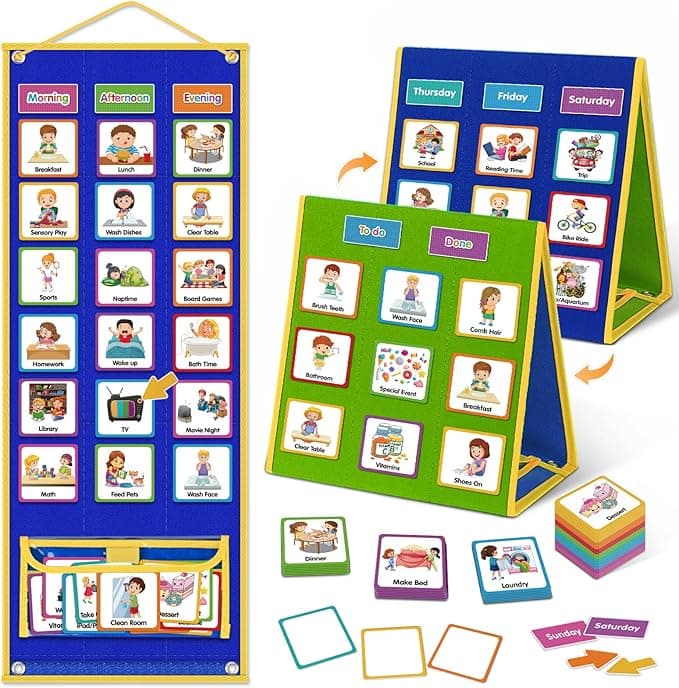
Godery Large Visual Schedule for Kids, Double-Sided Weekly Planner with 109 Cards
A big double-sided planner board with 109 pre-printed routine cards is a game-changer for younger kids who can't read a planner yet. They can see exactly what comes next and move the cards themselves as they finish each block, which makes transitions feel like a game instead of a fight.
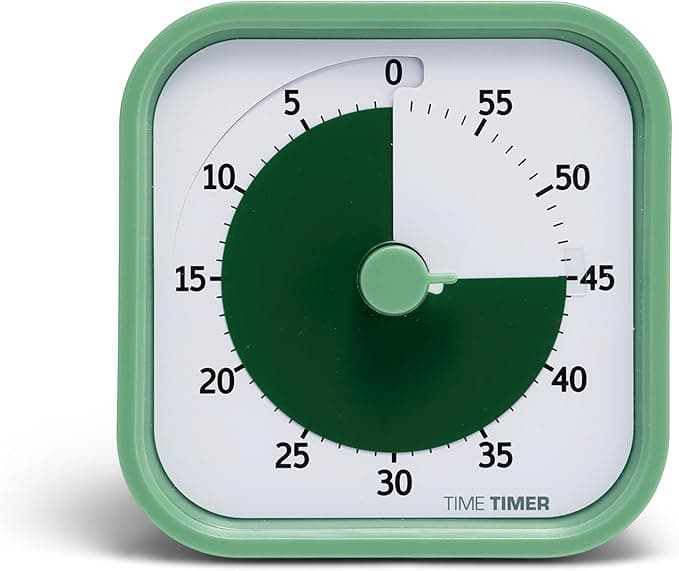
Time Timer Home MOD, 60-Minute Visual Countdown for Homeschool Desks
If you're trying block scheduling or short focused lessons, a visual timer takes the guesswork out of transitions and helps kids build a real sense of how long 20 minutes actually feels. The silent operation matters too, especially when a sibling is trying to concentrate on math nearby.
Managing Multiple Ages
If you have kids at different stages, scheduling gets more complex — but it's also one of homeschooling's secret strengths. Mixed-age learning is incredibly natural. Here are some strategies that help:
Combine what you can. History, science, read-alouds, art, music, nature study — these can all be done together with kids of different ages. You just adjust your expectations for the output. Your 5-year-old narrates orally. Your 10-year-old writes a summary.
Stagger independent work. While you're working one-on-one with your younger child on phonics, your older child does independent math. Then you swap.
Use "busy boxes" for littles. If you have toddlers or preschoolers, have a special box of activities that only comes out during school time — play dough, lacing cards, puzzles, coloring books. Rotate the contents weekly to keep them interesting.
Accept that it won't be perfect every day. Some days the baby is teething, the 4-year-old wants to do everything the 8-year-old is doing, and nobody can focus. That's a "read-aloud on the couch and call it a day" kind of day. And it counts.
What About the Afternoon?
One of the things I love most about homeschooling is that afternoons are usually free. Most homeschool families finish formal instruction by lunchtime or early afternoon. That leaves the rest of the day for:
- Free play (which is so important for development)
- Outdoor time and nature exploration
- Errands and life skills (grocery shopping is math, cooking is science)
- Sports, music lessons, or co-op activities
- Deep dives into personal interests
- Just being a kid
I used to feel guilty about our short school days until I realized how much learning was happening in those "free" afternoons. Building forts is engineering. Playing with friends is socialization and conflict resolution. Baking cookies is math, reading, and chemistry. Learning doesn't stop when the textbooks close.
Finding Your Rhythm
The schedule you start with probably won't be the one you keep. And that's exactly how it should be. Here's my advice:
Start looser than you think you should. You can always add more structure. It's much harder to pull back from a rigid schedule once everyone is stressed.
Pay attention to your family's natural energy. Are your kids sharpest in the morning? Do they need a slow start? Is there a mid-afternoon slump? Build around your rhythms, not against them.
Build in margin. Don't schedule every minute. Leave room for rabbit trails, spontaneous field trips, and the inevitable bad days.
Evaluate regularly. Every month or so, ask yourself: Is this working? Are the kids learning? Am I losing my mind? Adjust accordingly.
Give yourself permission to have "off" days. A day of documentaries and library books is still a school day. A day at the museum is a school day. A day spent gardening and cooking and reading together is a school day. Education is so much bigger than worksheets.