Perimenopause Mood Swings: Why You Feel Like a Stranger to Yourself
Perimenopause mood swings are not a character flaw. Here's the hormonal mechanism behind the irritability, rage, and anxiety, and what actually helps.

Disclosure: This post contains affiliate links. If you purchase through my links, I may earn a small commission at no extra cost to you. I only recommend products I genuinely love and believe in. Thank you for supporting Eventful Eve! 🤍
I cried in the car last Tuesday because the drive-through was out of the sauce I like. I want to be clear: I have been a functional, emotionally regulated adult for my entire life. I did not cry at weddings. I did not cry at funerals, necessarily. I cried once at a particularly sentimental Pixar film and felt embarrassed about it for a week. But here I was, 39 years old, sobbing in my parked minivan over a condiment. And twenty minutes later I was furious, pounding the steering wheel over a traffic delay. By the time I got home, I felt so drained I could barely speak. I spent the evening wondering what was wrong with me.
Nothing was wrong with me. I was just in the middle of perimenopause, and my hormones were doing something that nobody had warned me was coming. If you're having mood swings that feel disproportionate, unrecognizable, or outright terrifying, and you are somewhere in your mid-30s to late 40s, you need to know that this is real, it is common, and it is not who you actually are. It's a phase, with a mechanism and a path through.
What Perimenopausal Mood Swings Actually Look Like
The word "mood swings" makes it sound minor, like mild crankiness. That undersells what a lot of women actually experience. The emotional shifts of perimenopause can be intense, sudden, and scary, and they don't always fit the stereotype of weepy or sad.
Here are the specific patterns I've noticed in myself and heard from nearly every woman I know in this phase:
Disproportionate reactions. Something small happens (a traffic delay, a comment from your partner, a spilled drink) and your reaction is ten times bigger than the event calls for. You know it in the moment, but you can't seem to shrink it back down.
Rage that scares you. Sudden, hot, full-body anger that comes out of nowhere. I am not a yeller by nature. I have found myself yelling this year in ways I didn't recognize.
Anxiety that feels brand new. Many women who never considered themselves anxious suddenly develop significant anxiety in their late 30s or early 40s. Racing thoughts, tight chest, catastrophic thinking about things that never used to bother them.
Weepiness over nothing. Or things that didn't used to trigger tears. A song on the radio. A commercial. A memory from ten years ago. The emotional threshold feels lower.
Mood cycles that feel unrelated to your actual cycle. If you used to have predictable PMS, it may now feel like PMS for half the month. Or the emotional symptoms may shift to different phases of your cycle than you're used to.
Numbness or emotional flatness. For some women, the symptom isn't big emotions, it's the absence of them. Feeling blunted, distant, detached from joy or motivation.
Irritability with the people you love most. Your kids chewing. Your partner breathing. Your coworker's voice. Small things that used to be tolerable become intolerable.
Any of this is possible, and a lot of women experience several at once. It's exhausting, and the exhaustion itself compounds the mood symptoms in a nasty feedback loop.
The Hormones That Are Driving This
This is the part that, once I understood it, gave me enormous relief. The emotional chaos of perimenopause is not a failure of character or a sign that you're "just stressed." It's a predictable consequence of specific, measurable hormonal changes that directly affect brain chemistry.
Estrogen fluctuation is probably the biggest player. Estrogen increases serotonin activity in the brain, supports dopamine, and helps regulate the stress response. When estrogen levels are stable, it's quietly doing a lot of emotional regulation for you. When estrogen becomes erratic in perimenopause (spiking high one week, crashing low the next), your emotional regulation system is trying to calibrate against a moving target, and the result is emotional volatility.
Progesterone decline often happens first, sometimes years before estrogen changes become obvious. Progesterone enhances GABA activity, the brain's calming neurotransmitter system. When progesterone drops, you lose a significant portion of your built-in calming mechanism. This is why so many women experience new-onset anxiety, irritability, and sleep issues in their late 30s, even before their periods become irregular.
The ratio between estrogen and progesterone matters enormously. Even when each individual hormone is technically within a "normal" range, an imbalance between them (typically relatively higher estrogen, lower progesterone, called estrogen dominance) produces symptoms that include mood swings, anxiety, water retention, and sleep disruption.
Cortisol dysregulation compounds everything. Perimenopausal hormone shifts affect the HPA axis (your stress response system), and many women end up with either chronically elevated cortisol or cortisol dysregulation (too high at the wrong times, too low at others). Cortisol directly affects mood, anxiety, and emotional reactivity. I covered this in detail in signs your cortisol is too high.
Serotonin and dopamine changes follow from all of the above. These are your primary "mood" neurotransmitters, and estrogen supports both of them. As estrogen becomes erratic, so does serotonin and dopamine signaling. The emotional result can feel like rapid-cycling between too much and too little of everything.
Sleep disruption feeds back in. Poor sleep independently worsens mood. Perimenopausal hormone shifts disrupt sleep (more on this in perimenopause and sleep), which then makes the mood piece worse, which makes sleep worse, and so on.
Inflammation plays a role. Estrogen has anti-inflammatory effects. As it declines, systemic inflammation quietly increases, and inflammation is associated with depression, anxiety, and mood disorders.
When you understand all of this, the "you're just overreacting" framing becomes absurd. There is a documented, multi-system neuroendocrine transition happening, and your mood is part of how it shows up.
What Helped Me Stabilize (And What Didn't)
I've tried a lot of things over the past two years. Here's the honest rundown of what moved the needle.
Sleep Was the Biggest Single Factor
Every mood strategy I tried was being undermined by my sleep. Once I got serious about sleep (magnesium, a cool bedroom, screen limits, caffeine cutoff), the mood symptoms softened noticeably within two to three weeks. Not gone, but meaningfully less intense and easier to ride out.

Pure Encapsulations Magnesium Glycinate — 120mg Capsules
The single most impactful supplement I've added in perimenopause. Magnesium glycinate supports sleep, nervous system regulation, and mood. I take 400mg an hour before bed and it's non-negotiable now.
I wrote about magnesium specifically in benefits of magnesium for women. Of every supplement I've tried, magnesium glycinate has been the single biggest lever for mood stability, because it works through sleep, cortisol, and nervous system calming all at once.
Blood Sugar Stability Was Bigger Than Expected
I didn't realize how much of my irritability was blood sugar crashes until I started eating differently. Eating protein at breakfast (25 to 30 grams), not skipping meals, pairing carbs with protein and fat, and cutting back on sugary drinks made a surprisingly quick difference to my emotional baseline. Blood sugar crashes feel like mood crashes, and the two are neurochemically connected.
Strength Training, Again
The same cluster of interventions that helps with brain fog, weight changes, and sleep also helps with mood. Strength training 2 to 4 times per week improves insulin sensitivity, reduces anxiety symptoms, and builds emotional resilience. The post-workout mood effect is real, and the cumulative effect over weeks is substantial.
Ashwagandha for the Cortisol Piece
For the specific anxiety piece, adaptogens have been genuinely helpful. Ashwagandha in particular has the best research behind it for cortisol regulation and anxiety reduction in midlife women.
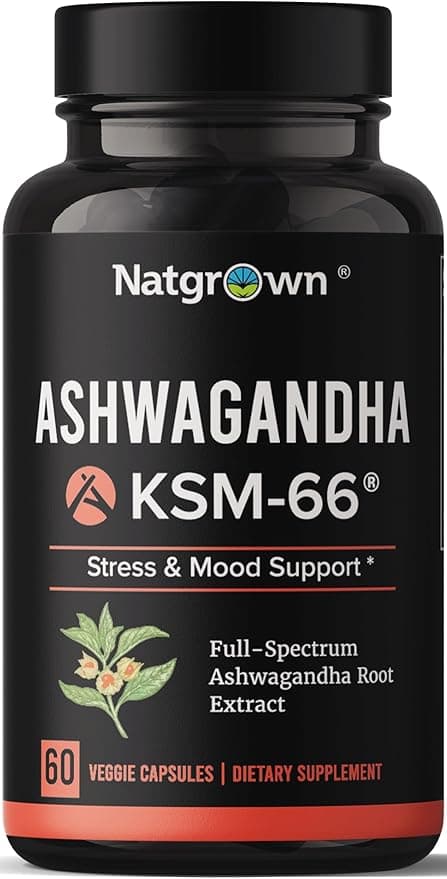
Natgrown Ashwagandha KSM-66 600mg — Organic Stress and Mood Support
KSM-66 is the standardized ashwagandha extract with the best clinical research for cortisol and mood. Noticeable effects over 4 to 6 weeks of daily use. This one sits permanently on my supplement shelf now.
Omega-3s for Inflammation and Mood
The research linking omega-3 fatty acids to reduced depression and anxiety symptoms in perimenopausal women is solid. I take a high-dose fish oil daily and consider it foundational.
Therapy, Specifically with Someone Who Understands Hormones
This one was significant. Not every therapist is familiar with perimenopause, and talking about hormone-driven mood changes with someone who frames them primarily as "learn better stress management skills" can be frustrating and unhelpful. A therapist who understands the hormonal piece (and can help you build coping tools specifically suited to this phase) is worth searching for.
Honest Conversations with My Partner
Perimenopause mood symptoms are hard on partners, and hiding what's happening or pretending you're fine makes it worse. Having a direct conversation about what's going on, what I'm doing about it, and what kind of support actually helps has made a meaningful difference. It also shifted the narrative in my house from "mom is unpredictable" to "our family is navigating a specific biological phase together."
What Didn't Help (For Me)
A few things that didn't move the needle, for transparency.
Generic "mood support" supplement blends. Almost all of these contain trace amounts of several herbs, rarely at meaningful doses. I spent money on several. Nothing noticeable.
Trying to push through. My instinct was to white-knuckle it and hope it passed. The emotional symptoms got worse the more I refused to address them directly.
Cutting caffeine cold turkey. I thought caffeine was driving my anxiety, so I quit entirely for a month. It made no significant difference, and I missed coffee. I ended up moderating (one cup in the morning, nothing after noon) rather than eliminating.
Alcohol as coping. I don't drink much, but on the nights I had a glass of wine, my sleep was worse, my mood the next day was worse, and the whole pattern was worse. Completely counterproductive.
Tools That Help in the Moment
For the acute waves of emotion, these have been genuinely useful.
Breath work, specifically longer exhales than inhales. Inhale for 4, exhale for 6 or 8. This activates your parasympathetic nervous system and can de-escalate a rage or anxiety wave within a couple of minutes.
Cold exposure. A cold splash of water on the face, or stepping outside into cool air, can reset an emotional spike quickly. The physiological effect is real.
Physical movement. A hard walk, a set of push-ups, a few minutes of dancing. Moving the body changes the emotional state more quickly than thinking does.
Naming the symptom out loud. "This is a hormone wave. It's not the situation." Just labeling it tends to reduce its grip.
Leaving the room. When possible, literally walking away for 15 minutes. Not every emotional wave needs to be processed in real-time with the nearest person.
A simple mantra. Mine is "this is temporary, this is biology, this is not me." I say it in my head when a wave hits.
When to Seek More Help
Not every mood symptom of perimenopause is manageable with lifestyle and supplement changes. If any of these apply to you, please reach out for professional support.
- Your mood symptoms are interfering with your ability to work, parent, or function.
- You're having persistent thoughts of hopelessness or suicidal ideation.
- You're using alcohol or other substances to cope at a level that concerns you.
- Your anxiety is preventing you from doing things you used to do (driving, socializing, working).
- You feel disconnected from your life or your loved ones in ways that feel persistent rather than waxing and waning.
- Your partner or close family members are expressing concern about changes they're seeing in you.
A good starting point is a doctor who's knowledgeable about perimenopause (many aren't, unfortunately, so it's worth asking specifically). The North American Menopause Society has a directory of certified practitioners. Hormone therapy helps a significant subset of women with mood symptoms, especially those who've tried lifestyle changes and haven't gotten enough relief. It's not the right answer for everyone, but it's a reasonable conversation to have with a knowledgeable doctor.
For crisis support in the US: 988 Suicide and Crisis Lifeline (call or text 988). You don't have to be actively suicidal to use it, just struggling more than you can manage alone.
What I Want You to Know
If you're in the middle of this right now, a few things I wish someone had said to me directly.
You are not crazy. The word "hormonal" has been used against women for so long to dismiss real experiences that even describing this as a hormonal phenomenon can feel invalidating. But the mechanism is real, the brain chemistry is real, and recognizing it isn't dismissing it. It's naming it accurately.
You are not becoming a worse version of yourself. The self you've been for decades is still in there. The mood waves don't replace your personality or your values. They just make it harder to be the version of yourself you're used to, for a season.
This will not last forever. The emotional intensity of perimenopause tends to be most acute in the few years before your final period, then eases significantly as hormones stabilize in postmenopause. You are passing through this. You are not moving to it permanently.
Getting help is not weakness. Therapy, medication, hormone therapy, supplements, support groups, honest conversations with loved ones, all of it is just practical tooling for navigating a demanding phase. Declining help to prove you don't need it is not noble. It's just harder than it has to be.
Your experience is common. Almost every woman in my life in this age range has some version of what you're describing. It has been criminally under-discussed, which is why we all think we're alone with it. We're not.
The Tuesday-condiment cry feels funny to me now, a few months later, because it was such a clear marker of a phase I didn't yet understand. I understand it now. My mood isn't fully back to what it was at 32, but it's meaningfully better than it was a year ago, and I know what to do when the waves come. You can get there too. Your brain is doing something hard, and once you meet it with the right support, it steadies.
You'll Also Love
- Perimenopause and Sleep
- Signs Your Cortisol Is Too High
- Perimenopause Symptoms in Your 30s
- Benefits of Magnesium for Women
- Ashwagandha Benefits for Women
- Natural Hormone Balance Tips